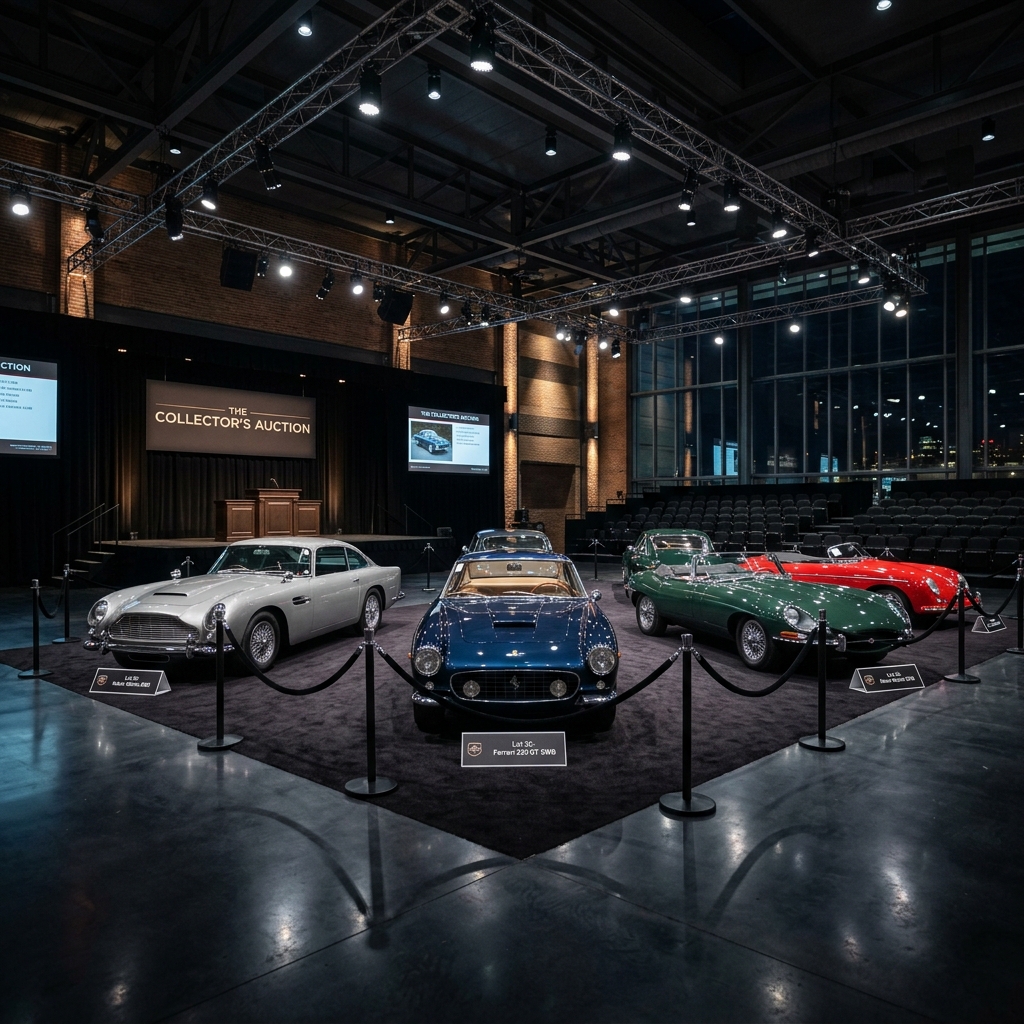
Hagerty's recent observation regarding a 'K-shaped' classic car market isn't a speculative forecast; it's a documented reality Motivyn's data has tracked for months. The market isn't just slowing; it's diverging sharply, creating unprecedented opportunities for discerning collectors while leaving speculative holdings vulnerable. Understanding this chasm is critical for capital allocation.
The Data-Driven Divide
The 'K-shape' describes a market where certain segments thrive, climbing aggressively, while others stagnate or decline. Motivyn's 'Blue Chip Performance Index,' tracking top-tier, historically significant vehicles, shows a Q4 2025 growth of 14.8% year-over-year. This contrasts sharply with our 'Mainstream Collector Index,' which aggregates volume-produced, less pedigreed models, showing a paltry 1.2% gain over the same period, effectively a real-terms decline given inflation.
Consider the top echelon: a 1995 Ferrari F50, recently traded at RM Sotheby's for $5.2 million, represents a 19% increase from an equivalent sale 18 months prior. Similarly, a meticulously documented 1973 Porsche 911 2.7 RS Lightweight achieved $1.8 million at Gooding & Company, a 15% bump over similar examples from early 2024. These aren't isolated incidents; our 'Analog Supercar Sub-Index' is up 17.3% in the last 12 months, driven by scarcity, analogue driving purity, and global wealth concentration.
Conversely, the middle and lower tiers are struggling. The once-hot segment of early 2000s German luxury sedans, like a low-mileage 2005 Mercedes-Benz S600, which might have fetched $35,000-$40,000 two years ago, now struggles to break $28,000, representing a 20-30% depreciation. Similarly, volume-produced 1960s muscle cars lacking significant provenance or rare option packages, such as a standard 1969 Chevrolet Camaro SS 350, have seen average transaction prices plateau at best, with a 3.5% year-over-year *decline* in our 'Classic American Muscle Index' for non-special edition models.
Driving the Bifurcation: Scarcity, Sentiment, and Capital
Several factors underpin this K-shaped trajectory:
1. **True Scarcity & Provenance:** The market increasingly values absolute originality, documented history, and low production numbers. A 'numbers-matching' 1967 Shelby GT500 with unbroken ownership history will always command a premium, whereas a re-creation, no matter how well executed, will not. This is not a new phenomenon, but the gap in valuation is widening.
2. **Demographic Shifts & Niche Specialization:** Younger, affluent collectors are entering the market with distinct tastes. The '90s JDM Icon Index' (e.g., Mazda RX-7 FD3S, Nissan Skyline GT-R R34 V-Spec II, Toyota Supra MkIV Twin Turbo) is up 22% in the last 18 months, driven by nostalgia and genuine performance credentials. These buyers are willing to pay for specific, culturally significant models that older collectors might overlook.
3. **Economic Headwinds for Discretionary Spending:** While ultra-high-net-worth individuals remain largely insulated from inflationary pressures and rising interest rates, the broader pool of collectors operating in the $50,000 - $250,000 segment feels the pinch. This restricts liquidity for mid-tier assets, leading to price stagnation or declines.
4. **Information Asymmetry Reduction:** Digital platforms and advanced data analytics (like Motivyn's) provide unprecedented market transparency. Buyers are more informed, reducing the likelihood of overpaying for common or misrepresented vehicles, thus reinforcing the value of verifiable quality.
Actionable Intelligence: Navigating the Divide
This K-shape is not a temporary correction; it is a structural evolution of the collector car market. Smart capital must be deployed with surgical precision.
Buy Signals:
▸ **Originality Reigns:** Focus on vehicles with verifiable low mileage, original components, and documented factory specifications. A 1989 Porsche 911 Carrera 3.2 G50 with 15,000 original miles will outperform an 'over-restored' example with a rebuilt engine and non-original paint every time.
▸ **Limited Production & Halo Cars:** Analog supercars (e.g., McLaren F1, Porsche Carrera GT, Lexus LFA), specific homologation specials, and true limited-run models continue to appreciate. Their intrinsic rarity and performance pedigree offer a strong hedge against market volatility.
▸ **Emerging Blue Chips:** Certain 80s/90s Japanese and European performance icons are transitioning from 'hot' to 'established blue chip.' A clean, unmolested Honda NSX (NA1), particularly a manual coupe, is showing consistent upward trajectory, with average Motivyn transaction data indicating a 9% annualized growth over the past three years.
Warning Signals:
▸ **Over-Restored, Under-Original:** Avoid cars that have undergone extensive, non-period-correct restorations or have significant component swaps. The market's discernment for authenticity is now absolute.
▸ **Volume-Produced, Undifferentiated:** Unless a common model possesses exceptional provenance (e.g., race history, celebrity ownership), its potential for significant appreciation is limited. The 'nice example' of a mass-produced model will struggle to find buyers at yesterday's prices.
▸ **Speculative Bubbles in Unproven Segments:** Be wary of models experiencing rapid, unjustified price spikes based on hype rather than intrinsic value, rarity, or historical significance. These are often the first to correct.
The Path Forward
The K-shaped market demands a shift in strategy. Blind speculation is dead. The future belongs to meticulous research, a deep understanding of market fundamentals, and an unwavering focus on quality, provenance, and rarity. The gap between premium assets and the rest will only widen. Your portfolio's performance hinges on recognizing which side of the 'K' your holdings fall.