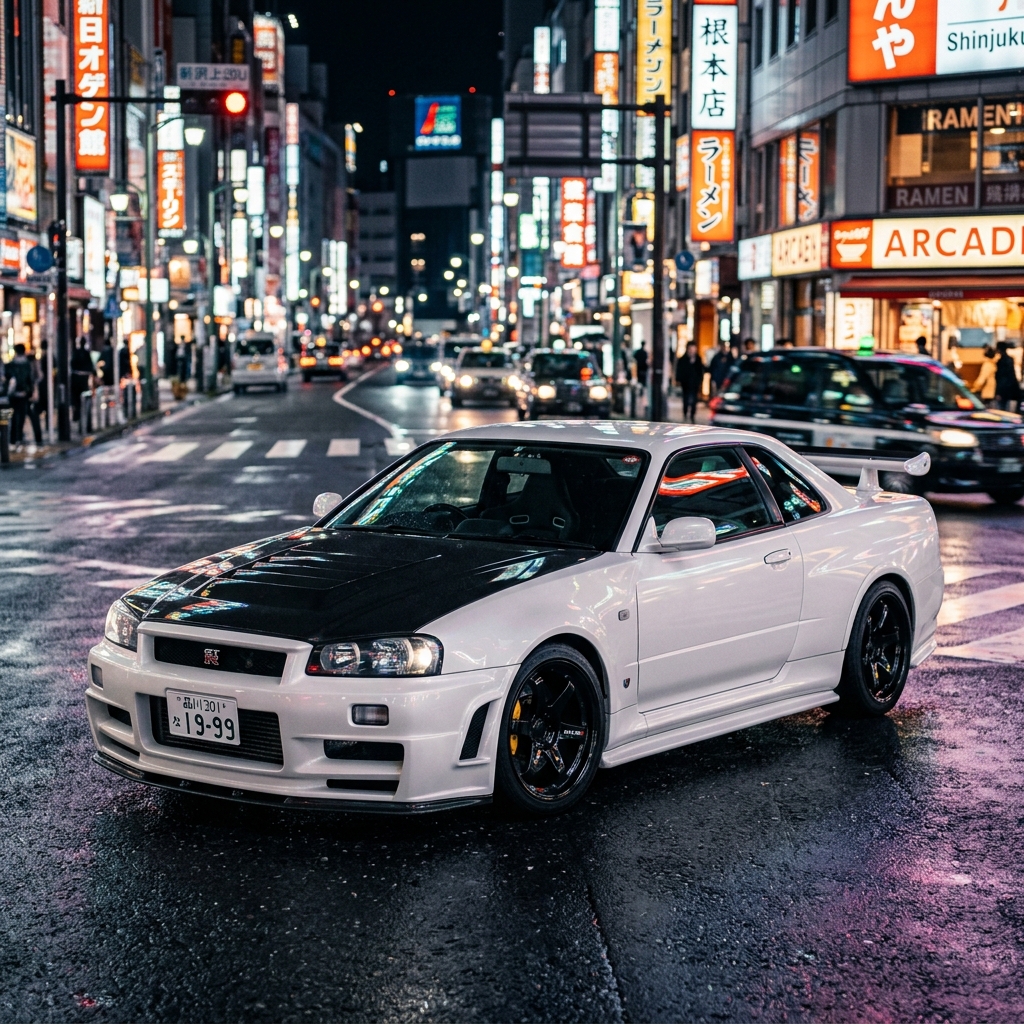
The Wait Is Over — And the Market Has Spoken
When the first R34 GT-Rs cleared U.S. customs legally in late 2023 and early 2024, expectations were already sky-high. Years of gray market appetite, a string of high-profile seizures, and a generation of Gran Turismo players with disposable income had created enormous pent-up demand. The question wasn't whether values would be strong — it was whether the market could absorb the units coming over without collapsing under its own hype.
Two years later, the data gives a clear answer: prices are high, selective, and showing no sign of broad correction. But the nuance matters.
What the Numbers Actually Say
R34 GT-R Base (RB25-powered V-spec and standard models) currently changes hands between $80,000–$120,000 in clean, documented condition. The RB26DETT V-Spec variants — the ones collectors actually want — are a different market entirely. Clean examples with low kilometers are routinely clearing $155,000–$210,000 at auction, with M-spec Nür and V-Spec II Nür examples pushing significantly higher.
The most significant result of 2025 was a documented, single-owner V-Spec II in Midnight Purple II that achieved $247,000 through a private dealer in California. That figure set a new anchor point for the mint condition end of the market.
Why Values Haven't Corrected
Three forces are keeping R34 values firm despite a broader softening in other JDM segments:
Supply remains genuinely constrained. Unlike the R32 (which had years of gray market saturation) or the R33 (which arrived legal with far less cultural cachet), the R34 production was smaller, global collector interest is larger, and the vast majority of low-kilometer examples never left Japan until 2024–2025. Import costs — compliance, shipping, inspection — create a natural $20,000+ floor above auction prices in Japan.
Condition stratification is extreme. The market isn't one market; it's two. High-mileage, modified, or poorly documented R34s sit in the $60,000–$90,000 range with weak demand. Unmolested, low-kilometer, original-paint cars face intense competition from serious collectors. The middle ground — modified cars being returned to stock — is the most active segment as owners try to reposition into premium territory.
Cultural demand is generational and durable. The buyers who grew up playing Gran Turismo 2 and watching The Fast and the Furious in theaters are now 35–45, with real money and emotional conviction. This cohort isn't buying R34s as diversified portfolio plays. They're buying cars they emotionally need to own. That creates price support that fundamentals alone can't explain.
What to Watch
The risk factor isn't demand — it's condition fraud. As values climbed, so did the incentive to misrepresent kilometers, address structural rust, and disguise accident history. Thorough PPI from an inspector who has physically handled R34s is non-negotiable. Japanese auction sheets are a starting point, not a verdict.
The opportunity is the base model V-spec — overlooked relative to the V-Spec II, mechanically identical at the core, and frequently available $40,000–$60,000 cheaper. As prices for premium variants price out casual buyers, institutional attention may pivot to well-documented base cars.
Forward Look
R34 GT-R values are not going to $500,000 in five years — that narrative ignores supply realities. But a sustained $180,000–$250,000 range for mint V-Spec IIs over the next decade is defensible given demand trajectory, cultural staying power, and the absolute scarcity of truly excellent examples. Buy condition. Avoid stories.