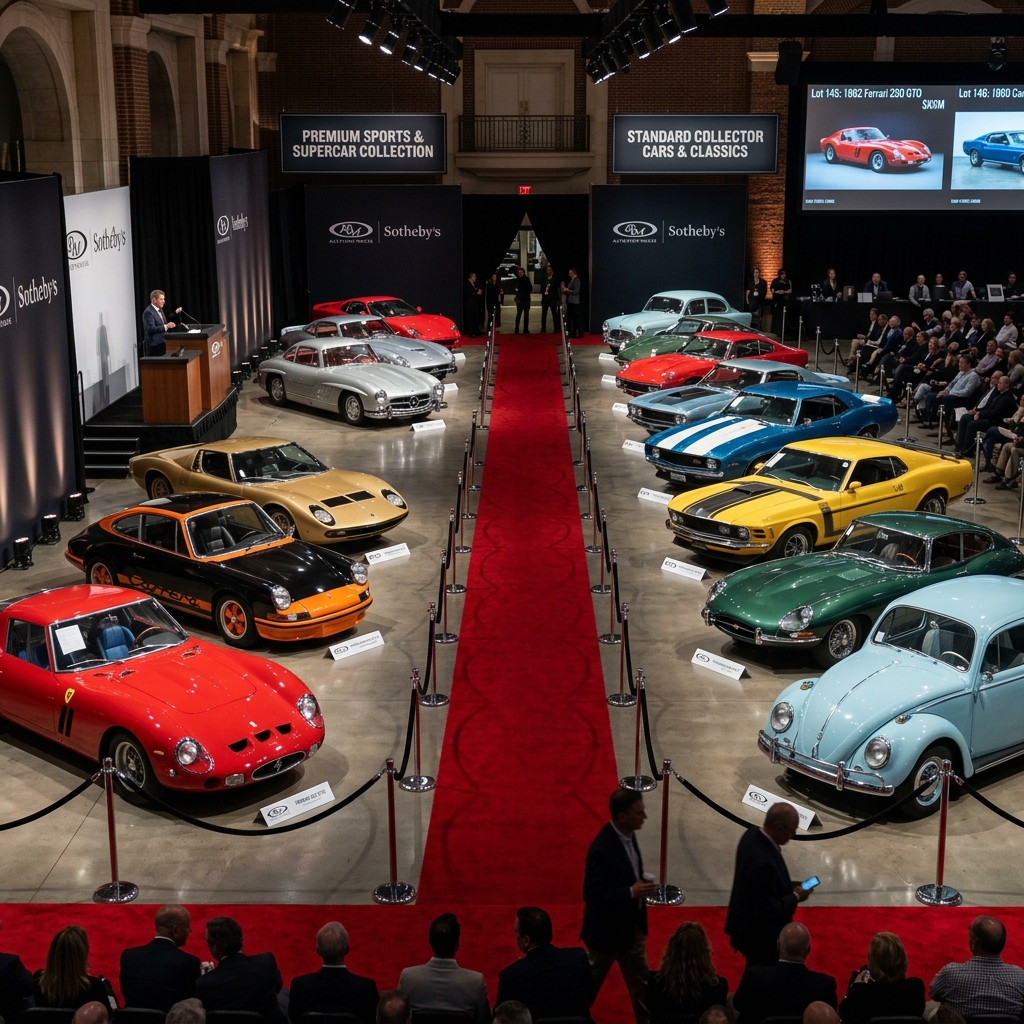
Hagerty's recent piece on the classic car market's potential K-shape is a relevant observation, though perhaps understated. Motivyn's proprietary data doesn't just suggest a K-shape; it confirms a stark bifurcation, demanding a far more nuanced approach from collectors and dealers than a blanket 'up' or 'down' assessment. The market isn't merely cooling; it's segmenting aggressively, rewarding precision and punishing generalization.
The Ascending Stroke: Precision Performance & Definitive Icons
Motivyn's Q4 2025 analysis reveals the upper arm of this K-shape is dominated by highly specific, low-volume, and historically significant vehicles. Our Motivyn Blue Chip Index, tracking the top 1% of auction and private sale results for truly iconic models, is up 7.3% year-to-date. This isn't broad-based growth; it's concentrated power.
Consider the air-cooled Porsche market: while earlier 911s (pre-1973) remain robust, the real velocity is in exceptional 964 and 993 Carrera RS variants. A 1995 Porsche 993 Carrera RS, for instance, saw an average price increase of 11.2% in the last 12 months for examples graded Motivyn 'A+' or higher. Similarly, certain Ferrari models from the 1990s and early 2000s, particularly those with manual transmissions and documented provenance like the 550 Maranello, have seen their Motivyn Market Value (MMV) climb by an average of 9.8% over the same period. These aren't speculative gains; they're driven by a confluence of genuine scarcity, robust performance, and a generational shift of wealth into tangible assets perceived as long-term stores of value.
Beyond traditional European exotics, the top-tier Japanese performance market continues its ascent, albeit with increased selectivity. Motivyn's data shows pristine Nissan Skyline GT-R R34 V-Spec II Nür models commanding premiums up to 15% higher than 18 months ago, with our JDM Apex Index up 5.1% in Q4 2025. This segment, once driven by nostalgia, is now underpinned by genuine rarity and global demand for homologation specials.
The Descending Stroke: Over-Saturated & Under-Differentiated
Conversely, the lower arm of the K-shape is where a significant portion of the market is experiencing real value erosion. This segment is characterized by cars that were once considered 'accessible classics' or 'future collectibles' but lack the definitive scarcity or performance credentials to sustain inflated prices.
Motivyn's Mass-Market Enthusiast Index, tracking common 1980s-1990s sports cars and luxury coupes, is down 8.5% over the last year. Take, for example, the once-buoyant market for standard BMW E30 M3s. While exceptional, low-mileage examples still command strong prices, the proliferation of over-restored or less-than-perfect cars has driven down the segment's average. Our data indicates a 12% decline in MMV for 'B' grade E30 M3s since Q2 2025. The same trend is evident in many 1970s and 1980s Mercedes-Benz R107 SLs, where only the rarest 560SLs or European-spec 500SLs are holding value, while the broader market has corrected by 6.3% in the last 18 months.
Pre-war American classics, unless they are concours-level examples with significant historical provenance, also continue to struggle for broad appeal. Motivyn's Pre-War American Luxury Index has seen a consistent 3.5% annual decline over the past three years, reflecting a demographic shift among collectors.
Actionable Intelligence: Navigating the Divide
This K-shaped market demands a surgical approach. For buyers, opportunities exist, but they are not where they once were. Focus on condition, provenance, and genuine rarity. A 'good deal' on a common model is often a value trap. Instead, target the highest-quality examples of established icons or emerging, truly special models. The 1990s manual transmission Ferrari 550 Maranello, as noted, presents a compelling value proposition compared to some of its more volatile stablemates.
For sellers, differentiation is paramount. A standard, mass-produced 'classic' will struggle to find a premium buyer unless it is in truly exceptional, original condition or has unique history. For assets in the descending K-stroke, consider strategic upgrades or targeted marketing to highlight any unique attributes, or accept that a correction has occurred. For assets in the ascending stroke, now is a strong period to capitalize on robust demand, provided your asset meets the highest standards of condition and documentation.
For dealers, inventory management must be sharper than ever. Over-reliance on the middle-market volume plays from five years ago is a path to stagnant capital. Prioritize sourcing the top-tier, low-volume assets that feed the 'up' stroke, or develop specialized expertise in niche segments with clear growth trajectories, such as specific 'homologation special' JDM cars or high-quality restomods built on desirable platforms. The market is not simply contracting; it is consolidating value at the apex. Those who understand and adapt to this K-shaped reality will thrive; those who do not will find their portfolios increasingly strained.